DALL-E 3 vs Stable Diffusion: We Tested Both for 3D App Icons
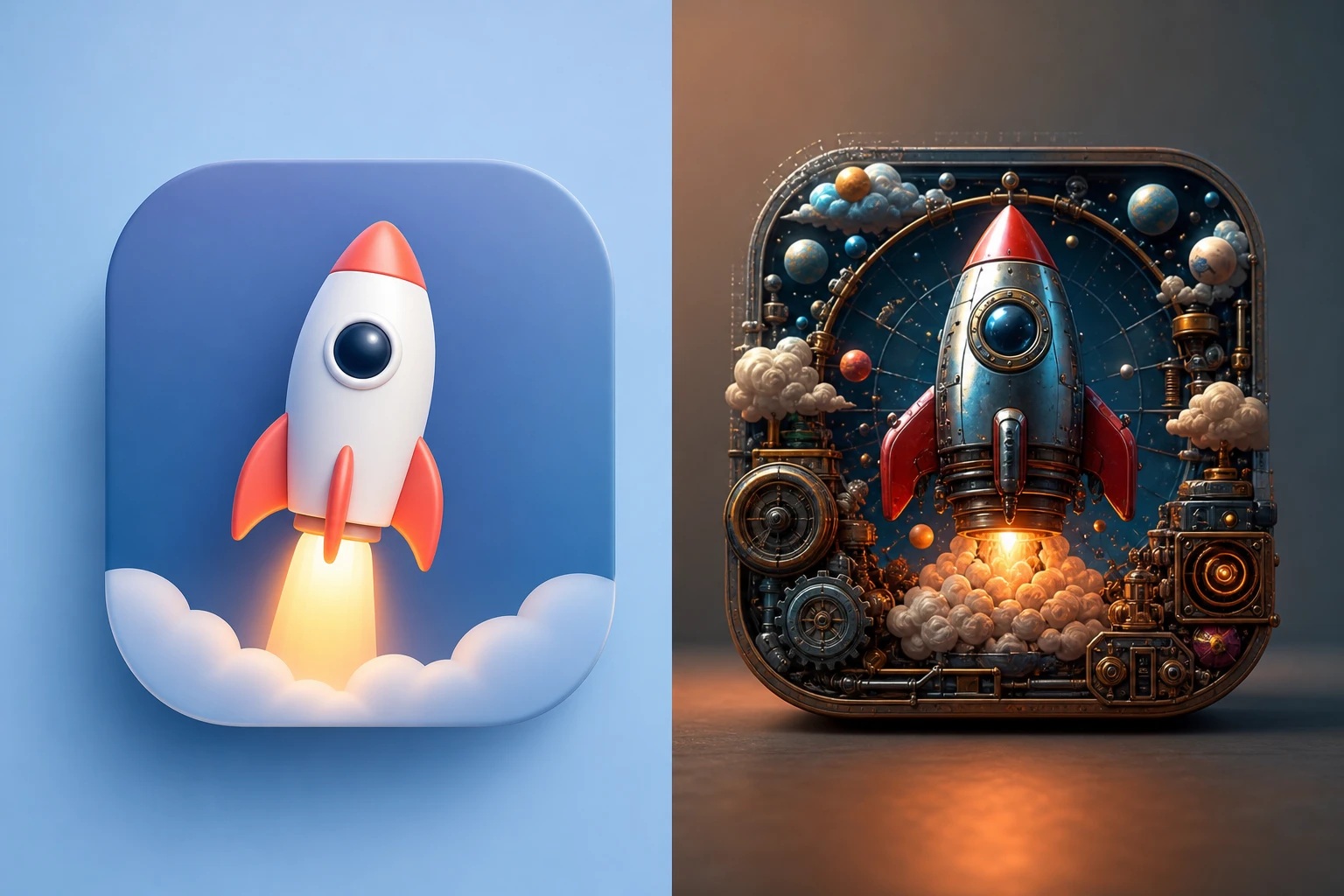
The world of AI image generation is dominated by two distinct philosophies: the smooth, conversational ease of OpenAI's DALL-E and the highly customizable, open-source powerhouse that is Stable Diffusion.
Both models have revolutionized how we create visual content, but UI design—specifically generating 3D app icons—they cater to entirely different workflows. Whether you are generating a quick conceptual mockup or tweaking parameters before exporting a final PNG, choosing the right ai 3d icon generator comes down to understanding their fundamental differences. Here is how DALL-E and Stable Diffusion compare when put to the test.
The Prompt Test: Side-by-Side Comparison
To see how these models handle UI assets, we ran a specific test prompt: "glossy 3D rocket icon, studio lighting."
DALL-E 3 generates images that follow prompts exceptionally well. Because it integrates directly into ChatGPT, the chatbot actually improves your prompt before rendering. The result is a highly polished, usable 3D icon on the first try. However, it often bakes in unwanted background gradients or complex shadows that make the asset difficult to isolate.
Stable Diffusion operates differently. Using its standard "txt2img" text-to-image script, the base model often struggles to give that perfect glossy, "Apple-style" 3D look out of the box without specific fine-tuning. It requires more trial and error, but once dialed in, it offers immense power and control over the final output.
The "White Halo" Problem and Transparent PNGs
One of the biggest hurdles in generating app icons with generalist AI tools is getting drop-in ready transparent PNGs. Neither of these models natively outputs images with true transparent backgrounds.
When you prompt DALL-E or Stable Diffusion for a "solid white background" and then run the output through a background removal tool, you almost always encounter the dreaded "white halo." This is a jagged, pixelated white fringe that clings to the glossy 3D edges of your icon. When you place that asset over a dark mode app interface, the halo ruins the clean UI aesthetic. Fixing this requires manual masking in traditional design software, entirely defeating the purpose of a fast AI workflow.
The Challenge of Visual Consistency
Creating one great 3D rocket icon is easy. Creating a cohesive suite of 10+ icons (a rocket, a gear, a user profile, a shopping cart) with identical brand style memory is where the real battle begins.
DALL-E 3 struggles significantly with visual consistency. Because it is a transformer-based model prioritizing conversational ease, keeping the exact same lighting, material (e.g., frosted glass vs. glossy plastic), and isometric perspective across a dozen icons is incredibly difficult, even if you feed it the same seed number.
Stable Diffusion, on the other hand, is built for this exact level of customizability,but only if you know how to wield it.
The Learning Curve: LoRAs and ControlNet
To get consistent 3D icons out of Stable Diffusion, you cannot just rely on text prompts. The true power of this open-source model lies in configuring advanced community-built tools.
You will need to use LoRAs (Low-Rank Adaptations) trained specifically on 3D icon styles to lock in the exact aesthetic across your entire icon set. Furthermore, you will need to utilize ControlNet to enforce the exact shape, silhouette, and isometric perspective across all your assets.
This represents a steep learning curve. While Stable Diffusion is small enough to fit inside consumer GPUs, setting up these advanced pipelines requires deep technical know-how and hours of configuration, whereas DALL-E 3 is simply a plug-and-play web interface.
Pricing Realities: The Hidden Costs
A major pain point for designers is understanding the true cost of these tools at scale.
To use DALL-E 3 effectively, you need a ChatGPT Plus subscription. This monthly fee might seem cheap initially, but strict usage caps can quickly bottleneck a large icon design project, forcing you to wait hours before generating your next batch.
Conversely, Stable Diffusion's code and weights are publicly released, meaning the underlying model is free. However, running it locally requires a powerful graphics card, meaning you are ultimately paying for the upfront hardware and ongoing electricity costs.
The Verdict
If you prioritize speed and need an AI that perfectly renders a one-off 3D concept on the first try, DALL-E 3 is the superior choice.
If you are a designer who needs absolute control over a consistent suite of 10+ icons and doesn't mind navigating LoRAs, ControlNet, and local hardware setups, Stable Diffusion is unmatched.
If this is the kind of work you're shipping, that's the gap we built Oven AI to close, open it the next time you hit this wall.