Midjourney vs ComfyUI: Which is Better for Consistent App Assets?
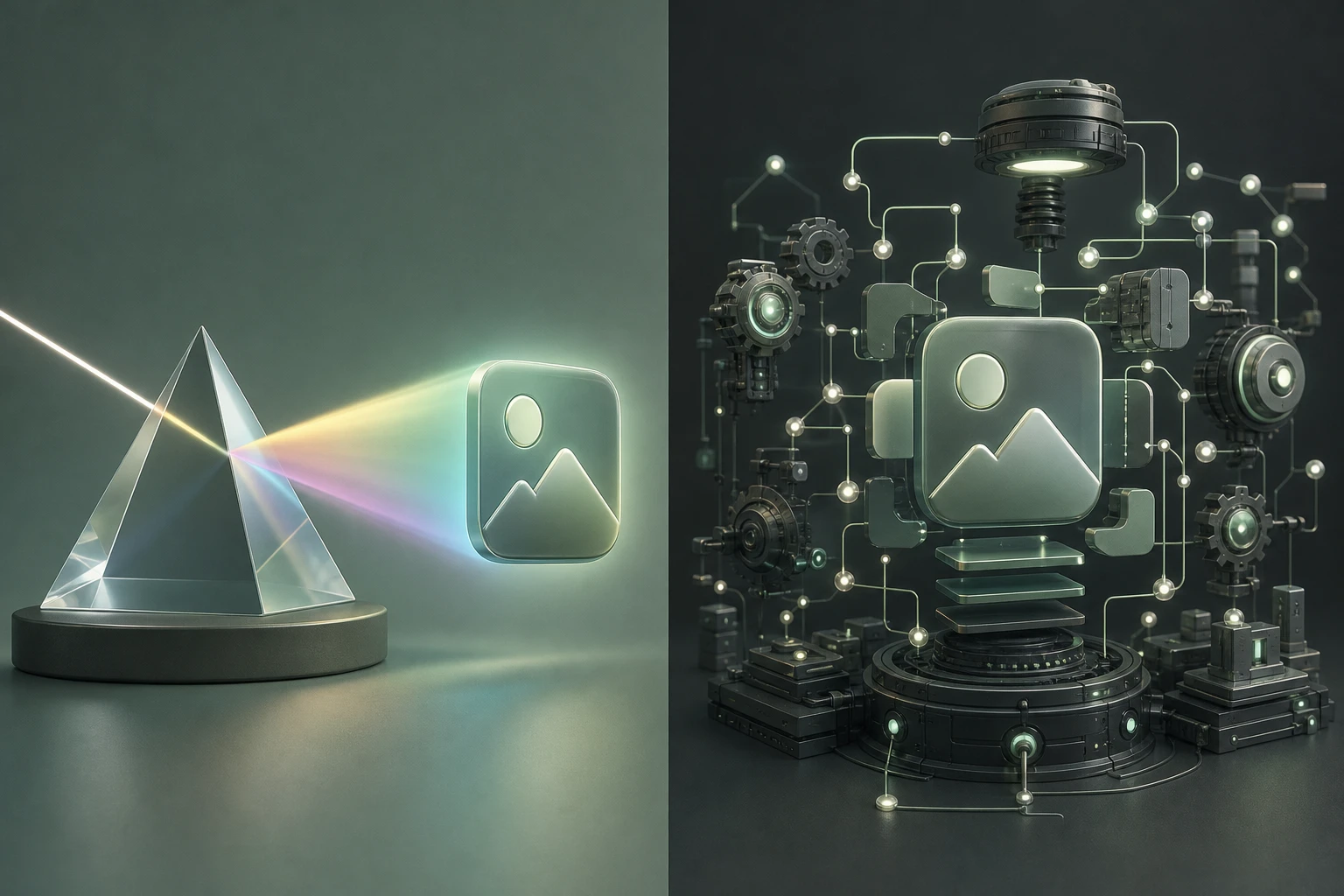
In the rapidly evolving landscape of AI image generation, creators are increasingly forced to choose between two distinct philosophies: the effortless artistry of closed ecosystems or the absolute control of open-source engines. As foundational models continue to improve, the debate between Midjourney and ComfyUI is no longer just about which tool makes a "better" picture—it is about workflow control, consistency, and generating usable UI/UX app assets without endless friction.
If you are building a professional design stack in 2026, here is how the two heavyweights compare and why product teams are quietly shifting their strategies.
Integrated Products vs. Modular Control (and the Hidden Costs)
The fundamental difference between the two platforms lies in their architecture. Midjourney is an integrated product where the user interface and the AI model are inextricably bound together. When you learn Midjourney, you are locked into their specific ecosystem and pay a monthly subscription ranging from $10 to $120 every month.
ComfyUI, on the other hand, is an open-source workflow engine that separates the interface from the model itself, allowing you to plug in state-of-the-art models as soon as they are released. However, while ComfyUI is technically a free program you install on your own computer, framing it as completely "free" ignores the hidden costs of running advanced AI. Running ComfyUI locally requires a highly capable, expensive GPU to process image generation pipelines efficiently. If you lack the hardware, you are forced to pay for ongoing hosted cloud services to keep your workflows running.
Escaping the "Slot Machine" of Prompting
Midjourney is famous for its moody, cinematic aesthetics, which require almost no effort to achieve. However, this artistic nature is a double-edged sword for UI/UX designers. Achieving precise, literal outputs—like clean app icons or maintaining perfect brand consistency,can be highly challenging without exhaustive prompt engineering.
Typical prompt-based solutions like Midjourney generally get you 60% to 80% of the way to your vision. To fix that remaining 20%, creators are forced to pull a proverbial "slot machine" of endless rerolls, hoping the AI guesses what they want.
ComfyUI eliminates this slot machine effect by offering granular precision over every parameter. Because it operates on a visual node graph, users can control every single step of the image generation pipeline. While it takes more tweaking to get Midjourney's signature artistic flair, ComfyUI clearly pulls ahead for realistic product mockups, precise edits, and generating brand-consistent marketing assets.
The UI/UX Workflow Gap: Reproducibility vs. Complexity
For indie makers and designers, the real challenge is building a repeatable house style. Midjourney struggles with perfect brand consistency across multiple assets. ComfyUI solves this through deterministic reproducibility: by setting a fixed seed generator, a pipeline will output the exact same picture every single time you execute it.
However, ComfyUI's massive node graph has historically been intimidating for non-technical users. While new features like App Mode are making it easier to run workflows without touching a node graph, piecing together a production-ready pipeline for app assets still requires significant technical overhead and a steep learning curve.
The Ultimate Solution for UI Designers: Oven AI
Neither Midjourney's slot machine prompting nor ComfyUI's complex node graphs natively cater to the rapid iteration cycles of UI/UX design. This is where Oven AI steps in to bridge the gap.
Oven AI is built specifically for product teams and indie makers who need production-ready app assets without the friction. Instead of wrestling with complex nodes or unpredictable prompts, Oven AI features Brand Style Memory, ensuring that every illustration, icon, or mockup perfectly aligns with your project's visual identity across your entire app.
Furthermore, Oven AI includes built-in automatic background removal, eliminating the tedious post-processing steps required when pulling assets from Midjourney or ComfyUI. It gives you the precise, ready-to-use transparent PNGs you need to drop straight into your Figma boards instantly.
The Verdict
If you need fast concepting with beautiful out-of-the-box aesthetics and don't mind a lack of granular control, Midjourney remains a pragmatic choice. If you require absolute parameter control, deterministic reproducibility, and are willing to invest in expensive local GPUs or cloud setups, ComfyUI is the definitive engineering tool.
But if you are a UI/UX designer or indie maker who just needs consistent, on-brand app assets without the technical headache, neither legacy tool is the perfect fit. Stop pulling the prompt slot machine and wrestling with node graphs,switch to Oven AI for a zero-friction workflow designed specifically for real product teams.
If this is the kind of work you're shipping, that's the gap we built Oven AI to close — open it the next time you hit this wall.